

Fiji’s resurgent economy and widening investment prospects took centre stage as Australian and Fijian business and government leaders gathered on the Gold Coast for the 29th Australia–Fiji Business Forum from 22 to 24 October 2025. Hosted by the Australia Fiji Business Council in partnership with the Fiji Australia Business Council, the annual forum remains the premier platform for dialogue on bilateral trade and investment.
The three-day programme opened with remarks from Zane Yoshida, President of the Australia Fiji Business Council, setting the tone for discussions focused on growth, resilience and deeper regional collaboration. Keynote addresses followed from Hon Manoa Kamikamica, Fiji’s Deputy Prime Minister and Minister for Trade, SMEs and Communications, alongside senior representatives of the Australian Government.
Justin Smirk, Pacific Economist at Westpac, provided an overview of Fiji’s economic outlook, framing the country’s recovery within broader regional trends. Panellists Saud Minam of the Asian Development Bank, Kelera Cavuilati of the Market Development Facility and Kamal Chetty of Investment Fiji offered insights into private-sector performance and investment promotion outcomes.
Sector-focused sessions explored emerging opportunities in business process outsourcing, led by Josefa Wivou of Outsource Fiji and Lisa Apted of KPMG Fiji, and in agricultural exports, with contributions from Hon Tomasi Tunabuna, Avi Rebera of the Australian Office of Drug Control and Zane Yoshida of The Calmer Co. Infrastructure, sustainability and digitalisation featured strongly on day two, with senior executives from Fiji Ports Corporation, Energy Fiji Limited, the Water Authority of Fiji and the Fiji Roads Authority outlining major projects and long-term development pipelines.
The programme also included discussions on green climate financing led by Professor Paul Dargusch of Monash Business School, and on trade facilitation with Tim Houghton of Austrade and Tim Martin of PTI Australia. A closing session on sports diplomacy highlighted its potential as a growing economic driver.
Across all sessions, delegates emphasised that Australia and Fiji increasingly view each other “not only as commercial partners, but as part of a closely connected Pacific community linked by cultural ties, labour mobility, sport and education exchange.”
Forum discussions underscored opportunities in infrastructure, tourism, agriculture, renewable energy, outsourcing and financial services. Speakers noted that improved air and sea connectivity — including new Cairns–Nadi services — is strengthening supply chains and supporting mobility for businesses and travellers.
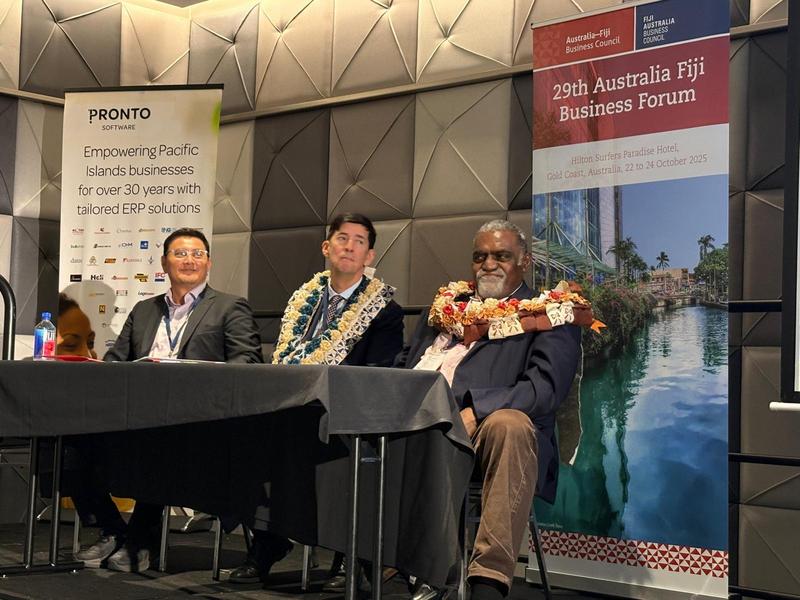
While global economic conditions remain challenging due to supply-chain disruptions, elevated borrowing costs and geopolitical realignment, delegates said these pressures are also creating space for strategic repositioning. Fiji’s tourism sector continues to perform strongly, and high-value exports such as processed agricultural products and Pacific wellness goods are gaining traction.
Financial inclusion remained a central theme, with speakers highlighting the importance of improving access to capital for MSMEs, women-led enterprises and community-based businesses. Initiatives focused on financial literacy, advisory support and enterprise growth are helping broaden economic participation and strengthen household resilience.
Infrastructure investment and the clean-energy transition were identified as critical to long-term competitiveness. Delegates pointed to opportunities in renewable generation, water and wastewater upgrades, tourism infrastructure and technology-enabled services, stressing the need for stronger project preparation, clearer regulations and contractor capability to accelerate delivery.
With its mix of plenary sessions, networking events and informal exchanges, this year’s forum offered rare access to decision-makers shaping Fiji’s next decade of economic development. Looking ahead, participants signalled a shared intent to translate strong diplomatic and cultural ties into deeper private-sector collaboration, climate-ready infrastructure and expanded trade and skills pathways.
Coordinated action between government, business and development partners, delegates said, will be essential to ensuring that progress is “sustainable and widely shared.”


