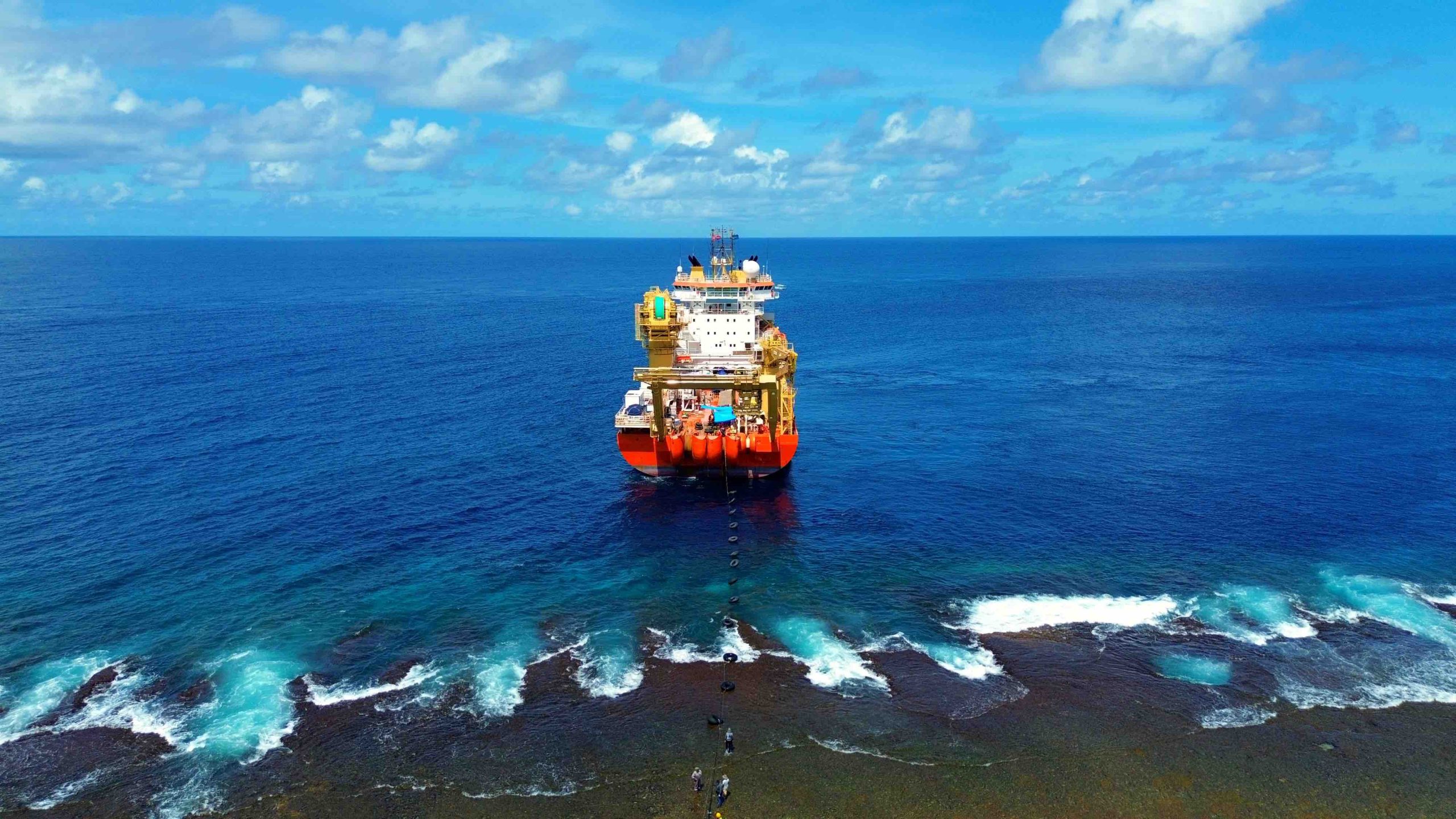
All Pacific Islands Forum members are now connected to the global undersea telecommunications cable network, marking a major expansion of regional digital infrastructure and opening new opportunities for trade, investment and economic development.
Australia said it had supported the delivery of more than 10,300 kilometres of new undersea telecommunications cables across the Pacific, extending high-capacity connectivity to some of the region's most remote island communities.
Australia has committed more than A$500 million since 2018 to undersea cable infrastructure across the Pacific and Timor-Leste, primarily through the Australian Infrastructure Financing Facility for the Pacific.
The investments have supported cable connections in **Papua New Guinea, Nauru, Solomon Islands, Timor-Leste, Tuvalu, Kiribati, the Federated States of Micronesia, Tonga and Palau**.
The milestone comes as Pacific countries seek to strengthen digital infrastructure, reduce telecommunications vulnerabilities and improve their integration with regional and international markets.
One of the latest projects is the 2,250-kilometre East Micronesia Cable, which became operational in mid-2026 and provided Nauru, Tarawa in Kiribati and Kosrae in the Federated States of Micronesia with their first international undersea cable connections.
The A$135 million project was delivered through a partnership involving Nauru, Kiribati, the Federated States of Micronesia, Australia, Japan and the United States. Australia contributed about A$65 million.
The connection is expected to benefit more than 100,000 people.
Other recent projects include Tuvalu's first international undersea cable, the Vaka Cable, which became operational in October 2025, and Tonga's second international connection, the Tu'i Vava'u Cable, commissioned in May 2026.
The additional connection to Tonga is expected to strengthen network resilience by reducing the risk of widespread telecommunications disruption if existing cables are damaged by natural disasters or other incidents.
Australia's telecommunications investments have been delivered in partnership with Japan, New Zealand, the United States and Taiwan.
Australian Foreign Minister Penny Wong said stronger connectivity would help Pacific economies participate more fully in the digital economy.
“A more connected Pacific is a more resilient Pacific,” Wong said.
“This infrastructure strengthens economic growth, supports essential services and will help underpin a more peaceful, stable and prosperous region.”
For Pacific businesses, improved connectivity could support the expansion of e-commerce, financial services, tourism, education, healthcare and other digital industries.
It could also allow governments to deliver public services more efficiently while improving access to international markets and investment.
The expansion addresses a longstanding infrastructure constraint for Pacific economies, where widely dispersed island communities have faced high telecommunications costs, limited network capacity and vulnerability to disruptions.
For Papua New Guinea, which is among the Pacific countries to have received support for undersea cable connectivity, improved international links provide additional infrastructure for businesses and government agencies seeking greater access to regional and global digital services.
Reliable telecommunications infrastructure is increasingly important to attracting investment, improving productivity and enabling Pacific businesses to participate in the wider digital economy.