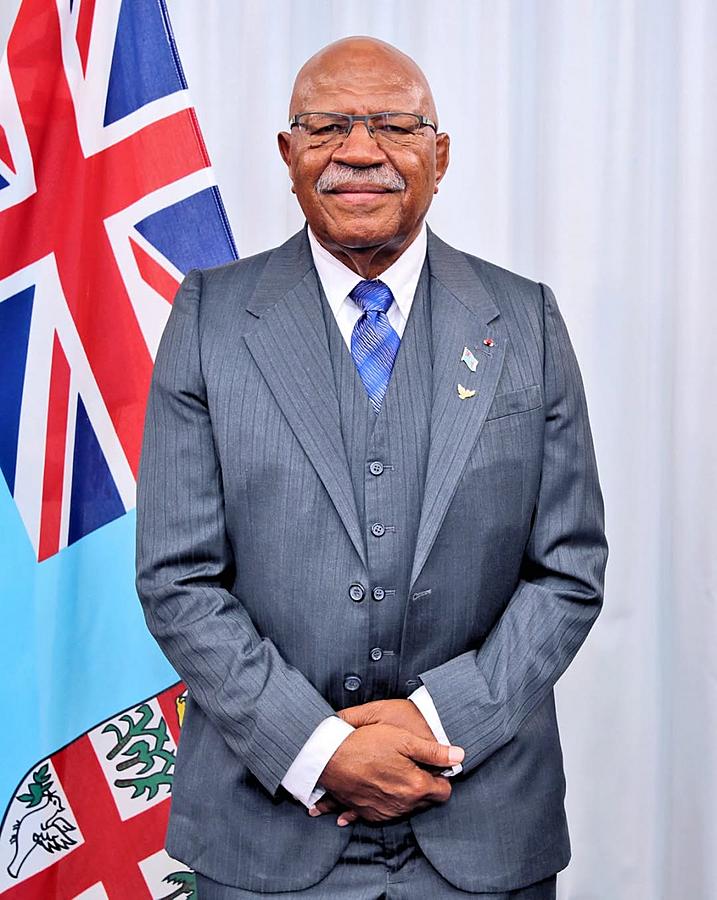
Fiji’s fuel supply remains stable despite mounting global price pressures, with the government moving to cushion households and key sectors from rising costs, Prime Minister Sitiveni Rabuka said.
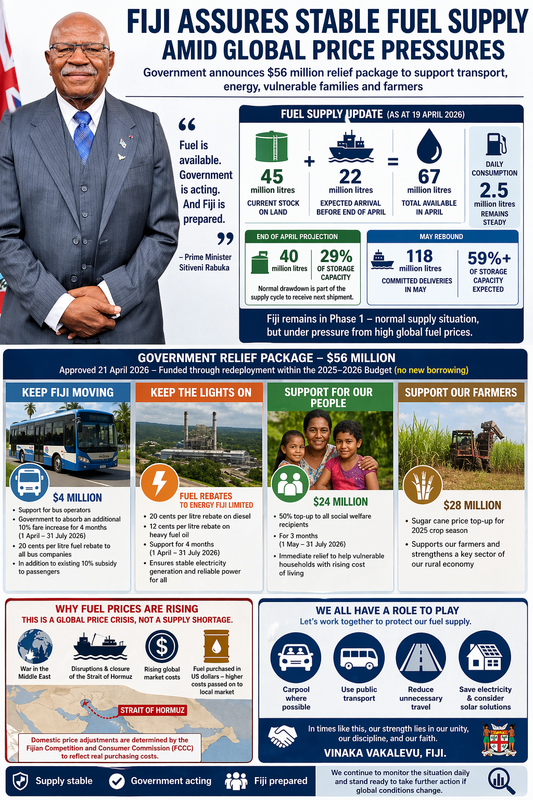
In a national address, Rabuka said Fiji currently holds about 45 million litres of fuel in onshore storage, with a further 22 million litres expected before the end of April, bringing total supply for the month to roughly 67 million litres. Daily consumption stands at about 2.5 million litres.
He said stock levels are projected to fall to around 40 million litres, or 29 percent of storage capacity, by month-end — a normal cycle to accommodate incoming shipments.
Looking ahead, suppliers have committed to deliver about 118 million litres in May, which is expected to lift national reserves to more than half of total capacity, keeping the country in what authorities classify as a “Phase 1” or normal supply condition.
Rabuka stressed that Fiji is not facing a supply shortage but rather a price-driven challenge linked to global market disruptions, including tensions in the Middle East and shipping constraints around the Strait of Hormuz.
Domestic price adjustments, he noted, are determined by the Fijian Competition and Consumer Commission to reflect international purchasing costs, with another increase expected in May.
To mitigate the impact, Cabinet has approved the redeployment of FJ$56 million within the existing 2025–2026 budget, shifting funds from delayed projects to immediate relief measures.
The government has earmarked FJ$4 million to support bus operators, including absorbing a 10 percent fare increase for four months and providing a fuel rebate of 20 cents per litre to maintain affordable public transport.
Fuel subsidies will also be extended to power utility Energy Fiji Limited to ensure stable electricity generation, while social welfare recipients will receive a temporary 50 percent top-up for three months starting May.
In the agricultural sector, FJ$28 million has been allocated to support sugar cane farmers through a price top-up for the 2025 crop season.
Rabuka said all measures will be funded through internal budget savings, alongside cost-cutting directives across government agencies.
“Fuel is available. Government is acting. And Fiji is prepared,” he said, urging citizens to conserve fuel and energy amid ongoing global uncertainty.