Canadian miner Lion One Metals Ltd. has reported high-grade gold intercepts from underground drilling at its Tuvatu Alkaline Gold Project in Fiji, including 4.6 metres grading 82.28 grams per tonne of gold.
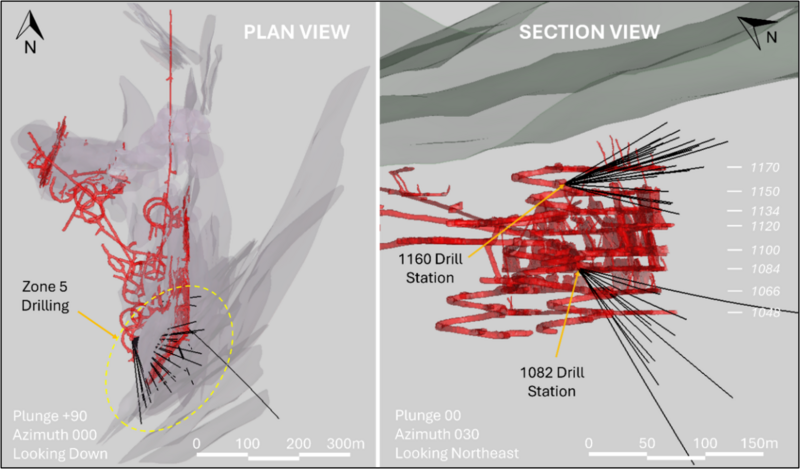
The results came from 4,370.2 metres of underground infill and grade-control drilling targeting extensions of the UR lodes in Zone 5, the company said in a Sept. 24 news release.
The drilling also returned 1 metre at 169.47 g/t gold, 1.1 metres at 153.94 g/t, 1.7 metres at 93.94 g/t and 0.3 metres at 285.13 g/t. The highest-grade individual intercept was 0.3 metres at 547.05 g/t.
Lion One said 30 of 34 completed drill holes intersected high-grade mineralisation, with most of the results located within 25 metres of underground development. The company expects the mineralisation to be incorporated into its mine plan within six months.
The drilling was conducted from the 1,160 and 1,082 underground drill stations. The former targeted mineralisation above the 1,150 level, while the latter targeted areas below the 1,066 level.
The Zone 5 drilling focused on the near-surface portions of the UR1 and UR2 lodes. Lion One said the UR2 lode has a strike length of about 620 metres and remains open along strike and at depth.
Lion One President and CEO Ian Berzins said the company was continuing to drill both Zone 5 and Zone 2 and was encountering high grades in both areas.
The company said the latest results included eight intercepts exceeding 100 g/t gold, following a previously reported intersection of 4.2 metres at 715.15 g/t gold from Zone 2.
Lion One operates the Tuvatu mine, which began operations in late 2023. The project includes the Tuvatu gold deposit, underground mine, pilot plant and assay laboratory. The company also holds an exploration licence covering the Navilawa Caldera, which contains multiple mineralised zones and exploration targets.
The reported drill intersections are downhole lengths, and true widths are not known, Lion One said. The company uses a 3 g/t gold cut-off for its high-grade composites.
This version follows AP style and British English, including metres, mineralisation, licence and programme-style usage where applicable.