
Kalo Gold Corp. has extended the identified surface gold mineralization corridor at its Wainikoro prospect in Fiji to 4.3 kilometres, strengthening exploration targets ahead of a planned drilling programme in January 2027.
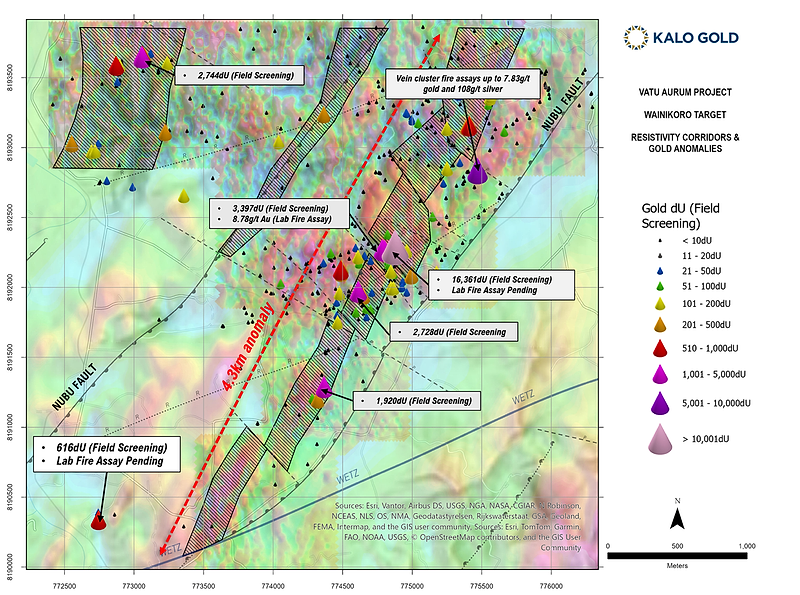
The Canadian-listed exploration company said a quartz vein sample collected at its 100%-owned Vatu Aurum Project on Vanua Levu returned 616 detectORE units, equivalent to an estimated 0.62 grams per tonne of gold.
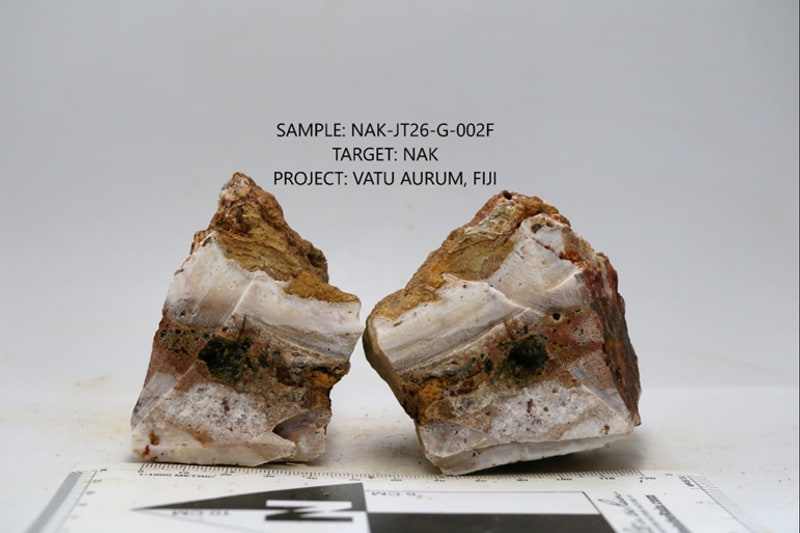
The sample, identified as NAK-JT26-G-002F, was collected about 1.8 kilometres southwest of the previous southernmost result along a structural corridor interpreted from an induced polarisation (IP) resistivity survey.
The latest finding extends the known occurrences of surface gold mineralization along the Wainikoro corridor to 4.3 kilometres.
Kalo said the sample came from a brecciated quartz vein containing iron oxide-filled cavities. It was collected downslope from an exposed quartz vein measuring up to 30 centimetres wide.
The company noted that detectORE results are semi-quantitative field-screening indicators and are not equivalent to certified laboratory assays. The estimated gold grade is provided for contextual reference and should not be relied upon for grade determination.
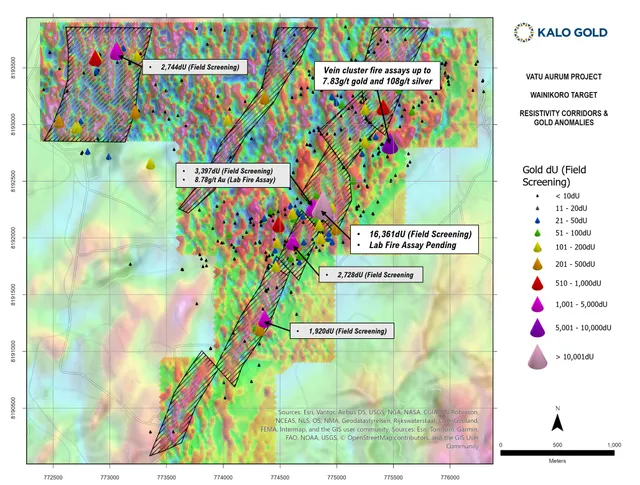
Previous sampling along the same corridor returned certified gold assays of up to 8.78 grams per tonne, as well as results of up to 7.83 grams per tonne of gold and 108 grams per tonne of silver.
Kalo President and Chief Executive Officer Terry Tucker said the latest result extended the surface mineralization footprint and highlighted the contribution of the company's field personnel.
The sample was identified by field staff while supporting geophysical survey crews, he said.
The company is now conducting follow-up prospecting and geological work to identify areas with sufficient width, grade and continuity to warrant drilling.
Geophysical surveys completed
Kalo said its controlled-source audio-frequency magnetotelluric (CSAMT) survey at Wainikoro was completed on October 26, while gravity surveying had also been completed.
The company is interpreting the geophysical data to refine exploration targets along the corridor.
Work scheduled through November and early December includes trenching to test resistivity anomalies identified through the gradient array IP survey, soil sampling, geological mapping and integration of the geophysical and geological datasets.
Tucker said the work would help the company identify priority targets for the planned January 2027 drilling programme.
The exploration programme is being conducted with support from Fender Geophysics and SGDS-HIVE, which worked alongside Kalo's field teams on the geophysical surveys.
The Vatu Aurum Project covers 367 square kilometres across Special Prospecting Licences 1511 and 1464 on Vanua Levu. It includes the Wainikoro and Aurum Prime exploration areas, which form part of a northeast-trending corridor of epithermal gold targets.
Kalo is using geological mapping, geochemical sampling, trenching, drilling and geophysical surveys to assess the project's mineral potential.
The company also disclosed that it granted 500,000 stock options to a consultant on October 23. The options are exercisable at $0.185 per share over five years, with half vesting after 12 months and the remainder after 24 months.
Kalo Gold is listed on the TSX Venture Exchange, OTCID Market and Frankfurt Stock Exchange under the symbols KALO, KLGDF and 9M51, respectively.