Kalo Gold Corp has reported a high field-screening result from a new gold occurrence at its Wainikoro exploration area in Fiji, as the Canadian-listed explorer advances preparations for drilling planned for January 2027.
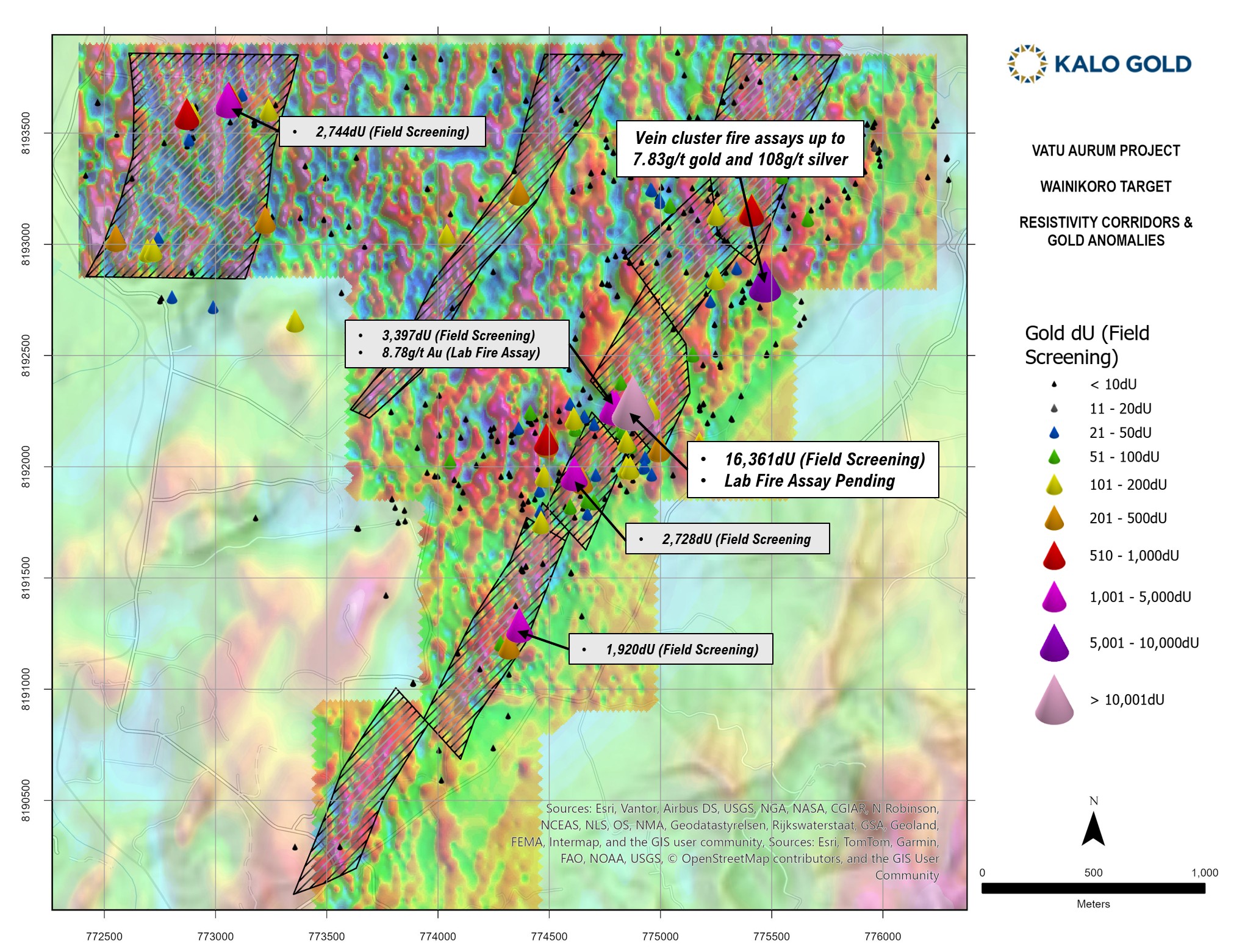
The company said a rock sample from Kope Road North returned 16,361 detectORE units, equivalent to an estimated 16.36 grammes of gold per tonne for contextual reference. Follow-up sampling also produced three additional elevated readings, expanding the area of interest at the company's 100%-owned Vatu Aurum Project on Vanua Levu.
Kalo stressed that the detectORE readings are semi-quantitative field-screening results, not certified laboratory assays. The estimated grades cannot be relied upon as definitive measurements of gold content.
The company plans to submit the highest-reading sample to ALS Ltd in Australia for fire-assay analysis and multi-element testing.
Follow-up samples return additional gold indications
The highest result came from sample KRN-LR26-G-035D, described as quartz-rich, silicified and brecciated tuff. The original outcrop had been disturbed by road construction, so the company collected samples from large pieces of rock uncovered at the site.
A subsequent sampling traverse returned readings of 3,956 units, equivalent to an estimated 3.96 grammes per tonne, from silica-rich breccia; 2,110 units, or about 2.11 grammes per tonne, from silicified brecciated tuff; and 863 units, or about 0.86 grammes per tonne, from silicified quartz-vein material.
Kalo said the results provided additional targets for geological mapping, geophysical surveys and trenching. However, the samples were selective rock samples and do not establish the average grade or continuity of mineralisation.
The Kope Road North occurrence is about 900 metres south-west of the New Vein Cluster, where previously reported certified assays returned up to 7.83 grammes of gold per tonne and 108 grammes of silver per tonne.
Both areas lie along an interpreted induced polarisation (IP) resistivity corridor. Kalo cautioned that their proximity does not demonstrate continuity of mineralisation.
Surveys and road works advance ahead of drilling
Kalo has completed a gradient-array IP survey at Wainikoro and is conducting controlled-source audio-frequency magnetotelluric (CSAMT) surveying to investigate the geometry and depth of interpreted resistivity corridors.
Mechanised trenching at Kope Road North is providing additional geological exposure to help assess the geophysical targets.
The company has also begun road upgrades to prepare for drilling during the wet season. About 1.6 kilometres of road improvements have been marked out, including the installation of three culverts and the placement of aggregate to improve access and safety.
Kalo plans to deploy one drill rig from January 2027 to test priority targets at Wainikoro. The schedule remains subject to factors including weather, ground access, equipment availability and financing.
President and chief executive Terry Tucker said the follow-up sampling had identified multiple gold responses around the original sample and that the company was moving towards systematic drill testing.
The company intends to combine the IP and CSAMT data with trenching, geological and structural mapping, geochemistry, field screening and certified laboratory assays to refine its geological model and prioritise drill targets.
Exploration targets remain unproven
Vancouver-based Kalo Gold is exploring the 367-square-kilometre Vatu Aurum Project, which comprises Special Prospecting Licences 1511 and 1464 on Vanua Levu. Its exploration programme focuses on a north-east-trending corridor of low-sulphidation epithermal gold targets, including Wainikoro and the flagship Aurum Prime area.
The company said its exploration work has identified multiple structurally controlled targets supported by drilling, trenching, soil geochemistry, structural mapping and airborne geophysics.
No mineral resource or mineral reserve has been estimated for the Vatu Aurum Project, and the targets remain conceptual.
Kalo said the results from the pending fire assay, together with ongoing geophysical work and trenching, would help determine the next steps in evaluating the Wainikoro targets.