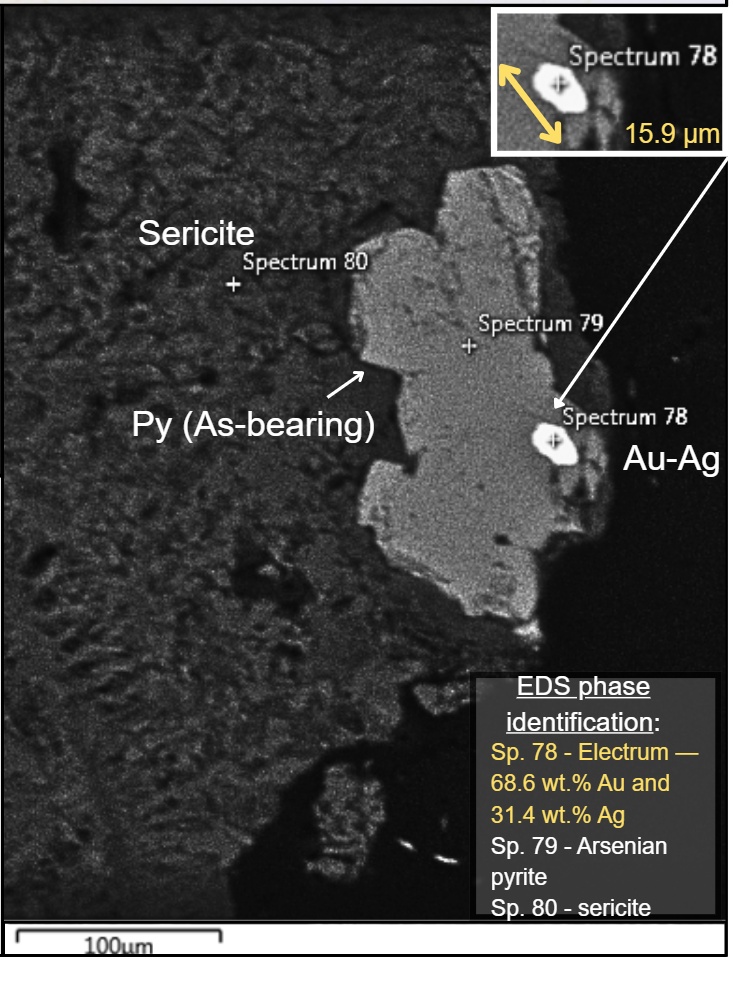
Kalo Gold Corp. has identified electrum, a naturally occurring gold-silver alloy, in drill core from its Wainikoro prospect within the Vatu Aurum Project in Fiji, providing further insight into the mineralisation and potential drill targets.
The Vancouver-based company said on 29 September that the electrum was identified in 2026 drill core from its 100%-owned project during an MSc research study conducted by Heidi Walton of the Camborne School of Mines at the University of Exeter.
Scanning electron microscopy with energy-dispersive X-ray spectroscopy identified a discrete electrum grain measuring about 20 micrometres in drill hole VA26-DH19.
The grain contained approximately 68.6% gold and 31.4% silver by weight and occurred against the margin of an arsenian pyrite grain within a sericite-bearing matrix.
The sample was collected between 189.88 metres and 191 metres downhole and comprised polymictic volcanic breccia cut by quartz-carbonate veinlets and containing disseminated sulphides.
Kalo Gold president and chief executive Terry Tucker said the finding provided direct mineralogical evidence of a gold-silver phase within the Wainikoro hydrothermal system.
The company said the study supported a structurally controlled hydrothermal model in which repeated fracturing, brecciation and reopening of veins created pathways for mineralising fluids through volcanic rocks.
Additional analysis of drill core samples identified pyrite, arsenian pyrite, sphalerite, chalcopyrite and pyrrhotite associated with quartz-carbonate veining, sericite, chlorite and locally brecciated volcanic rocks.
Kalo Gold said the observed textures indicated multiple episodes of brittle fracturing, vein formation, reopening and sulphide deposition.
The principal assayed gold interval in VA26-DH19 returned 1.61 grams per tonne gold over 1.5 metres at about 150 metres downhole, a result previously reported by the company in June.
Material near the interval contained crackle brecciation, quartz-rich fracture infill, pyrite, arsenian pyrite and sphalerite.
The company said multivariate analysis of drill-core geochemistry also identified a broader gold-silver-arsenic-antimony-lead-molybdenum hydrothermal association.
Gold showed its strongest statistical relationships with lead, silver and molybdenum, while arsenic and antimony formed a broader pathfinder signature.
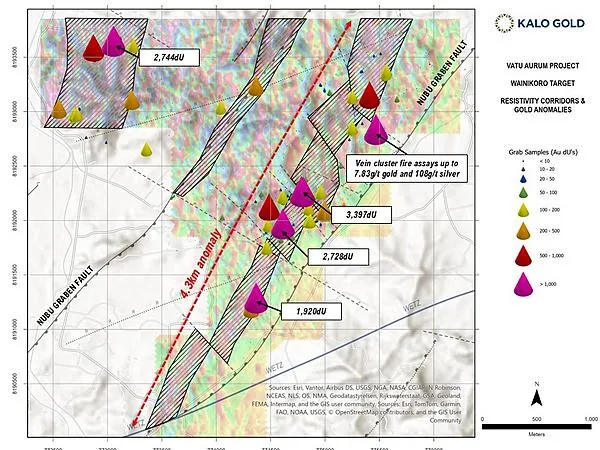
Prospectivity modelling identified areas where elevated gold and arsenic responses coincide with interpreted structural corridors. Kalo Gold said these areas would provide additional criteria for prioritising future trenching and drilling.
Surface mapping around trench TR009 and VA26-DH19 identified quartz and quartz-carbonate veins along northeast- and north-northwest-trending structures, while regional magnetic interpretation identified intersecting structural trends that may have created zones of increased permeability.
The company cautioned that only one discrete electrum grain was identified among the 12 polished thin sections examined. It said other fine-grained gold-bearing phases could remain undetected and that further mineralogical and gold-deportment studies would be required.
Kalo Gold also said the study does not establish the continuity, grade or economic significance of mineralisation at Wainikoro, with further trenching, drilling, assaying and mineralogical work required.