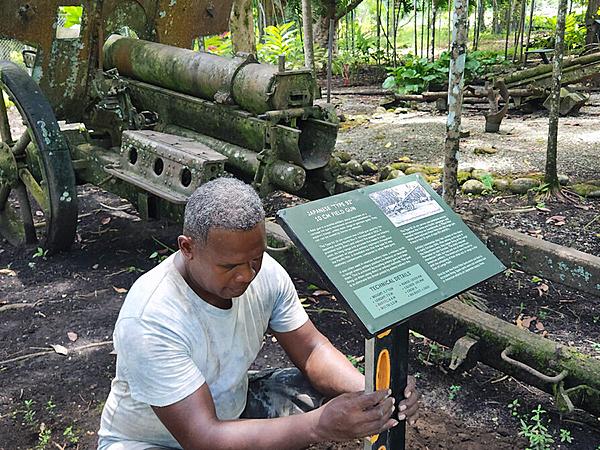
A New Zealand-funded grant has helped the Vilu War Museum in West Guadalcanal improve visitor interpretation, with 30 new signs providing historical context for the World War II relics preserved at the site.
The Vilu War Museum, which holds one of the Solomon Islands’ most significant collections of large World War II relics, has completed the production and installation of new interpretive signage with support from a grant facilitated by Business Link Pacific (BLP).
The Solomon Islands WWII Heritage Association (SIWHA) applied for the grant on behalf of the museum in April 2025. The project was developed in response to the museum’s growing number of cruise ship visitors and the need to provide clearer information about the exhibits in the outdoor museum park.
The collection includes the remains of Japanese and American aircraft and artillery pieces associated with the Guadalcanal Campaign of 1942–43, during which major battles were fought on and around Guadalcanal.
Bringing greater context to WWII relics
The grant supported the production and installation of 30 interpretive signs throughout the museum grounds.
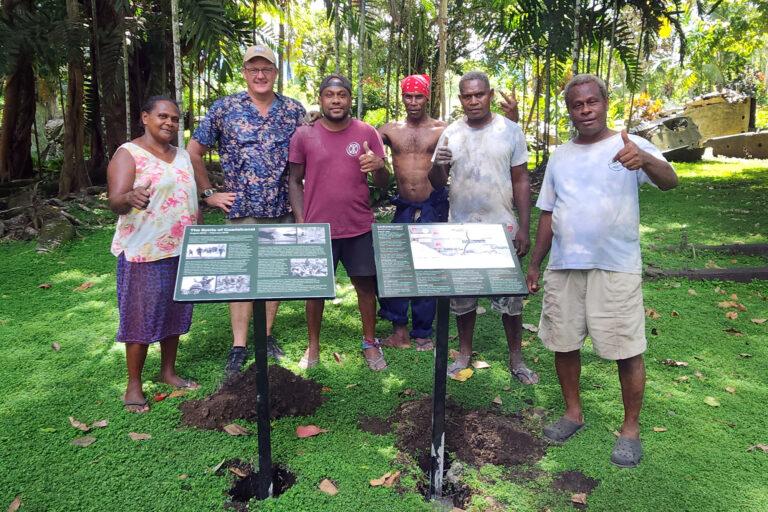
Two large overview signs were installed at the entrance, providing visitors with background on the Guadalcanal Campaign and its key battles. The remaining signs were positioned alongside individual exhibits, linking the historical information directly to the aircraft, artillery and other wartime relics on display.
The museum said the project represented an important improvement to the visitor experience.
“Thanks to a New Zealand–funded grant from Business Link Pacific, we’ve been able to produce 30 new interpretive signs for the outdoor exhibits — a big step toward improving the visitor experience and preserving these stories for future generations,” the museum said.
The signage project also made extensive use of local participation. Graphic design was completed in-house, while installation was carried out by volunteers from the Vilu War Museum and SIWHA.
As a result, almost all of the grant funding was spent directly on producing the signs through a local sign maker, keeping the project focused on the intended visitor improvements.
Longer visits and stronger visitor engagement
The museum has reported changes in how visitors interact with the site since the signs were installed.
Visitors are now tending to stay longer, while the additional information has also reduced the need for museum staff to personally guide every visitor through the outdoor exhibits.
The museum said visitors have responded positively to having more detailed historical interpretation available at each display.
Tour operators have also provided positive feedback, with some sharing photographs of the museum and its exhibits on social media, helping increase the site's visibility as a heritage tourism attraction.
For a museum built around physical remnants of one of the Pacific's most significant World War II campaigns, the project demonstrates how relatively modest visitor infrastructure can improve the way historical sites are experienced and understood.
Supporting Pacific tourism businesses
The Vilu War Museum project was supported through Business Link Pacific, which facilitates small and medium-sized enterprise access to business advisory services and financial support.
BLP provides online tools that allow businesses to assess their needs, including its Business Health Check, Business Continuity Planner and Climate Action Sensor. Businesses can also connect with local BLP partners for face-to-face diagnostic support.
For Vilu War Museum, the grant has provided a practical investment in interpretation while supporting the museum's ability to accommodate growing visitor numbers and preserve the historical stories associated with the Guadalcanal campaign.