TE Pacific Group, through its Papua New Guinea operation TE PNG, has entered into a strategic partnership with Lightspeed Fiji to strengthen and expand information and communications technology (ICT) services across Fiji.
The partnership combines TE PNG’s proven experience in delivering large-scale ICT and critical communications projects across the Pacific with Lightspeed Fiji’s strong local market presence and service delivery expertise.
Together, the companies aim to provide businesses, government agencies and communities with reliable, secure and high-performance ICT solutions.
TE PNG is the core of TE Pacific Group, a technology integration company operating in Papua New Guinea, Solomon Islands, Australia and across the South Pacific. With more than 70 years of history in Papua New Guinea, TE has established itself as a leading provider of end-to-end critical communications and ICT infrastructure solutions.
On the other hand, Lightspeed Fiji is a leading Fijian ICT and internet services provider offering high-speed connectivity, cloud solutions and managed services to businesses, government and communities nationwide.
The company is Fiji’s first Starlink Authorised Reseller in the Pacific Islands and a Starlink vendor to the Government of Fiji.
“This partnership reflects our shared commitment to building a stronger, more connected Pacific,” said Robbie Huxley, managing director of TE PNG and CEO of TE Pacific Group.
“With Lightspeed Fiji’s local expertise and our regional capabilities, we can deliver enhanced ICT services and critical communications that support economic growth, digital innovation and improved connectivity for the people of Fiji,” Huxley added.
Lightspeed Fiji Country Manager Dovi Kanaimawi said, “Working with TE PNG allows us to access world-class regional infrastructure while keeping a strong local presence. This means faster, more secure services, greater coverage and the capacity to meet Fiji’s growing ICT needs.”
Key focus areas of the partnership include:
By combining international capacity with local expertise, TE PNG and Lightspeed Fiji aim to accelerate Fiji’s digital development and position the country as a regional ICT hub.
Richard Broadbridge, managing director of Lightspeed’s Papua New Guinea and Fiji operations, said that TE PNG and Lightspeed have enjoyed a close working relationship in Papua New Guinea for more than a decade.
“This Fiji partnership is a natural extension of our shared vision to deliver better services to customers across the Pacific,” Broadbridge said
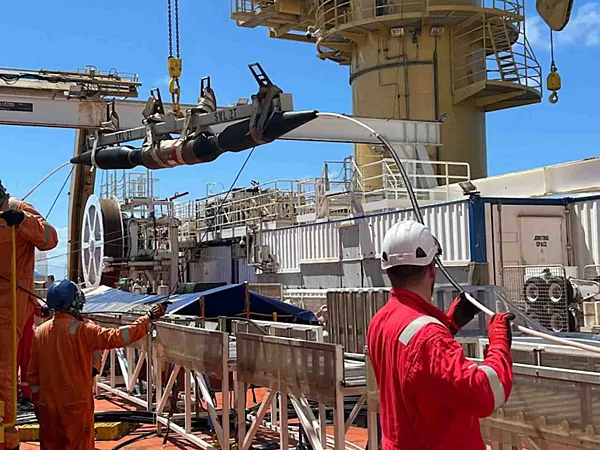
The East Micronesia Cable landed in Tarawa, Kiribati on 26 July 2025 with the international telecommunications cable now just months away from being ready for service.
The occasion was marked by a ceremony celebrating the floating in of the cable to the Tarawa landing site from the cable-laying ship, using a large ceremonial buoy. Kiribati President Taneti Maamau and the Minister for Information, Communications and Transport Alexander Teabo hosted the event alongside senior representatives of the Kiribati government and officials from the project’s partner governments.
Among those in attendance were Australia’s Special Envoy for the Pacific Ewen McDonald, Australia’s High Commissioner to Kiribati Mark Foxe, Chargé d'Affaires ad interim of Japan to the Republic of Kiribati Suzuki Hideyuki and Mr Michael Glees, Senior Development Adviser at the U.S. Embassy in Suva.
The AUD135 million (approximately USD90 million) East Micronesia Cable project is funded by Australia, Japan and the United States. It will deliver a 2,250-kilometre-long undersea cable and supporting infrastructure, connecting Tarawa in Kiribati, Nauru and the state of Kosrae in the Federated States of Micronesia (FSM) to the existing HANTRU-1 cable landing point in Pohnpei, FSM.
The project will improve the availability of digital government services and enable increased trade and employment opportunities. It will also enhance the countries’ resilience to climate change, supporting governments with disaster and climate preparedness while reducing the risk of outages during extreme weather events.
Ceremonial buoy events to mark the cable landings in Nauru and Kosrae will be held in the coming weeks. The cable is expected to be ready for service in November 2025.
Nick van Voorst is an Australian Registered Migration Agent (MARN: 0640648), a Registered Education Agent (M042) and the owner of Coral Coast Migration Service.
He has studied Australian Migration Law at Griffith University in Brisbane and has been working as a Registered Migration Agent since 2006. He is a member of the Migration Institute of Australia and is based in Cairns. The company provides professional advice for people wishing to apply for an Australian Visa and specialises in Student, Tourist, Employer Sponsored, General Skilled, Partner and other Family Visas, as well as Australian Citizenship Applications. We are also Registered Education Agents and represent Education Queensland International, Cairns College of Business and English, and can assist with enrolments in other colleges and universities around Australia.
A Registered Migration Agent will make sure that your application is well presented, professionally prepared and meets all requirements. The agent will assist with the completion of all necessary forms, collating of documents, preparation of submissions and the lodgement of your application. He will monitor the progress of your application and provide ongoing advice and liaise with the Department of Home Affairs on your behalf.
All Australian Registered Migration Agents must have Immigration Law qualifications and must abide by a strict Code of Conduct.
We offer reasonable, fixed fees, agreed upon in advance, excellent, regular communication, support and feed-back.
Our Services:
Education Queensland International (EQI) develops and promotes programs for international students who want to study at a Queensland Government primary or secondary school.
Education Queensland International has more than 95 schools in Cairns, Townsville, the Fraser Coast, the Gold Coast, the Sunshine Cost and Brisbane that welcome international students to study the Queensland curriculum.
This includes primary schools that offer programs from Prep to Year 6 and high schools that offer programs from Year 7 to 12, including the International Baccalaureate.
These schools provide an internationally recognised academic curriculum, and many offer vocational training and special programs. Extra-curricular activities are also available.
Most schools are close to universities and Technical and Further Education (TAFE) institutions, and many have partnerships with them that could benefit students. This includes an easy path to further study and future goals.
International students enrolled in primary school must stay with a parent or Department of Home Affairs (DHA) approved relative. If you are a high school student, you may choose to live with a parent or a close relative who lives in Queensland.
The alternative accommodation option for high school students is staying with a local Queensland family from your school. This is called a homestay. Staying with a local family is a great way to enjoy the Australian way of living.
Important: enrolment application deadlines:
For further inquiries, please visit our website: https://www.coralcoastmigrationservice.com.au/
The Bank of Papua New Guinea (BPNG) has submitted its 2024 Annual Report and Financial Statements to the Minister for Treasury, in accordance with the Central Banking (Amendment) Act of 2024. The report captures a pivotal year marked by structural reform, digital innovation, monetary tightening, and renewed focus on institutional integrity.
The timely submission of the report reflects the Bank’s commitment to transparency, discipline and legal compliance. It outlines the central bank’s operational performance, policy direction and audited financial results for the year ending 31 December 2024.
“Publishing our Annual Report is more than a legal obligation. It is an important mechanism for communicating the work of the Bank and being accountable to the people of Papua New Guinea,” Governor Elizabeth Genia said.
The Bank recorded a net operating profit of K242.2 million (approx. US$65 million), a significant increase from K44.2 million (approx. US$11.8 million) in 2023. Operating income rose to K770.1 million (approx. US$207 million), largely due to stronger returns from foreign currency investments, while total expenditure was contained at K527.9 million (approx. US$142 million). The distributable profit remains under Retained Earnings, pending a decision by the Board.
In a separate press release, the Bank confirmed a dividend payment of K48.5 million (approx. US$13.1 million) to the National Government as part of its reporting process. This transfer reflects the allocation of distributable profit from the net operating profit of K242.2 million (approx. US$65 million), in accordance with statutory requirements following independent audit and review.
The process is consistent with international central banking and accounting standards, and forms part of the Bank’s annual financial cycle, the bank said.
Under the amended Central Banking Act, 80 percent of distributable profit is retained in the General Reserve Account until minimum capital thresholds are met. The Bank also recorded K837.8 million (approx. US$225 million) in unrealised gains transferred to the Unrealised Profits Reserve, and K114.1 million (approx. US$30.6 million) to the Gold Reserve, in line with international accounting standards. No funds were transferred to the General or Building Reserve accounts in 2024.
A major development during the year was the passage of the Central Banking (Amendment) Act 2024, which followed Phase II of the Independent Advisory Group (IAG) review. The legislation restructured the Bank’s governance and formally established a new Monetary Policy Committee (MPC), which will take over responsibility for setting monetary policy from 2025.
Throughout 2024, the Bank maintained a tightening monetary stance to address foreign exchange imbalances, contain inflation, and absorb excess domestic liquidity. Key reforms under an IMF-supported programme included the implementation of an interest rate corridor, adjustments to the cash reserve requirement (CRR), and the launch of weekly foreign exchange auctions.
By year-end, BPNG had conducted 26 foreign exchange auctions totalling more than US$1 billion, significantly reducing order backlogs and enhancing transparency. The kina depreciated by 6.8 percent against the US dollar during the year, under a managed "crawling peg" strategy intended to restore currency convertibility while managing inflation risks.
Despite currency depreciation, inflation remained contained. The trimmed mean inflation rate rose by just 3.3 percent over the year. However, the Bank noted that deposit and lending rates in the private sector were largely unresponsive to policy adjustments — highlighting continued weaknesses in the interest rate transmission mechanism.
Institutional reforms progressed in parallel. A new executive structure, aligned with the Bank’s Vision 2050 strategy, was approved by the Board. Each executive position is now explicitly linked to strategic priorities and key performance indicators.
Board Chair David Toua OBE commended the Bank’s operational discipline and ethics reforms. He acknowledged the dismissal of a number of staff involved in the manipulation of employee benefits, calling the swift action essential for maintaining the Bank’s credibility. “Ethics is equally vital to governance,” Mr Toua said. “The integrity of BPNG must be beyond reproach.”
The Bank also continued to expand financial inclusion and digital innovation. It issued commercial banking licences to three new institutions: TISA Bank, Credit Bank PNG, and the state-owned National Banking Corporation (formerly People’s Micro Bank). These approvals marked the most significant expansion of PNG’s banking sector in years.
In March 2024, the Bank launched the Green Finance Centre in partnership with the Global Green Growth Institute (GGGI), the New Zealand Ministry of Foreign Affairs and Trade, and other development partners. The Centre supports the implementation of the Inclusive Green Finance Policy and aligns with PNG’s Third National Financial Inclusion Strategy.
The Bank also completed major technological upgrades, including enhancements to the Kina Automated Transfer System (KATS), expansion of mobile and digital payment services, and support for fintech development under its Regulatory Sandbox framework.
Regionally, BPNG maintained strong partnerships through forums such as the South East Asian Central Banks (SEACEN) group and the Pacific Islands Central Bank Supervisory College. It also contributed to PNG’s second Mutual Evaluation under the Asia Pacific Group on Money Laundering, which identified critical reforms needed to avoid grey-listing by the Financial Action Task Force (FATF).
Governor Genia reaffirmed the Bank’s long-term focus on inclusive growth, financial soundness, and institutional renewal. “None of this progress would be possible without the tireless work of our staff, the strategic guidance of the Board and the trust of the people of Papua New Guinea,” she said.
With the Monetary Policy Committee set to assume policy-making duties in 2025, and Vision 2050 implementation gaining momentum, the Bank of Papua New Guinea enters the new fiscal year with stronger financial, operational, and governance foundations, the report added.
Follow on LinkedIn:
Pacific Business Review
Be the "First" to get our exclusive Digital Magazine & Weekly Newsletter.