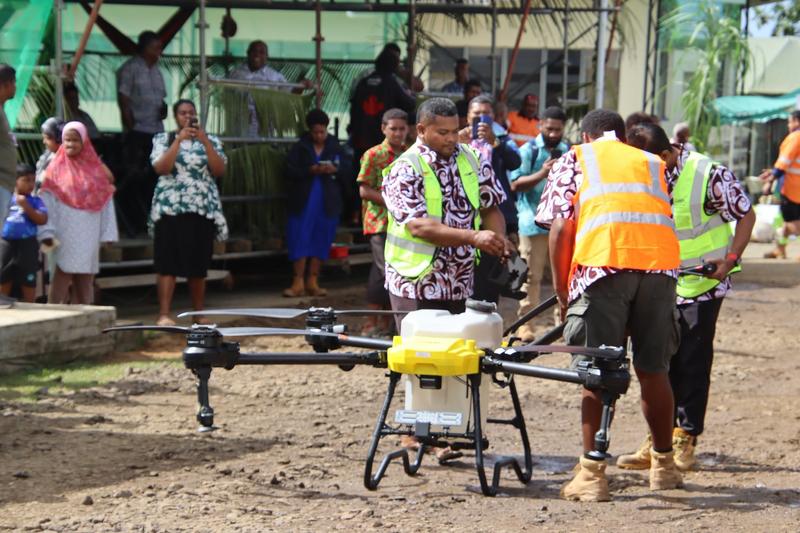
The Fiji government has reaffirmed its commitment to agricultural research and innovation, describing them as critical to strengthening food security, economic resilience and climate preparedness in the face of growing global and environmental challenges.
Finance, Commerce and Business Development Minister Esrom Immanuel made the remarks while officiating at the Koronivia Research Station Open Day, where he highlighted the role of science and technology in supporting sustainable agricultural development.
"This event showcases the critical role that science and technology play in enhancing agricultural productivity, sustainability, and food security for our nation," Immanuel said.
The minister said that while prudent fiscal management remains a national priority, long-term economic stability depends on a strong and resilient agricultural sector capable of withstanding external shocks.
Reflecting on the Covid-19 pandemic, Immanuel noted that agriculture played a crucial role in sustaining livelihoods and economic activity when Fiji's tourism sector, one of the country's main economic drivers, was severely affected.
"When tourism was severely impacted, agriculture sustained livelihoods, maintained economic activity, and demonstrated its strategic importance to Fiji's economic security," he said.
Immanuel commended the Ministry of Agriculture, Waterways and Sugar Industry and its research teams for developing practical solutions to address climate change, strengthen food production and reduce reliance on imports.
Among the achievements highlighted were the development of drought-tolerant and disease-resistant crop varieties, innovations in cassava flour blending and organic composting, improved cultivation methods for traditional root crops, and climate-resilient production technologies designed to help farmers maintain yields under challenging conditions.

The minister said investments in agricultural research generate long-term national benefits by reducing disaster recovery costs, improving domestic food production, lowering import dependence and supporting economic growth.
He pointed to the government's record allocation of FJ$115 million to the Ministry of Agriculture, Waterways and Sugar Industry in the current financial year as evidence of its commitment to the sector.
The funding includes FJ$2.7 million for rice research, rice farming support and irrigation maintenance, as well as FJ$772,800 for the mass production of quality seeds and planting materials.
Immanuel also acknowledged the contribution of development partners in strengthening Fiji's agricultural research capabilities, including the Australian Centre for International Agricultural Research, the Food and Agriculture Organization of the United Nations, the European Union, the United Nations Development Programme and the International Fund for Agricultural Development.
Looking ahead, he called for stronger collaboration among government agencies, development partners, academic institutions, the private sector, researchers and farmers to further institutionalise agricultural research and development across the country.
He also encouraged farmers and industry stakeholders to adopt research-driven innovations, embrace improved crop varieties and implement sustainable farming practices to improve productivity and resilience.
Concluding his address, Immanuel paid tribute to the country's scientists and researchers, describing them as being on the frontline of protecting Fiji from hunger, inflation and climate-related challenges before officially opening the Koronivia Research Station Open Day.