Solomon Islands Prime Minister Matthew Wale says the country's narrow economic base is the result of decades of policy choices rather than an unavoidable reality, pledging reforms aimed at delivering broader economic benefits to ordinary citizens.
Responding to the Speech from the Throne in Parliament this week, Wale said the country's economic structure had been shaped by decisions made — and not made — over more than 40 years.
"A small and narrow economy is not our destiny," Wale said.
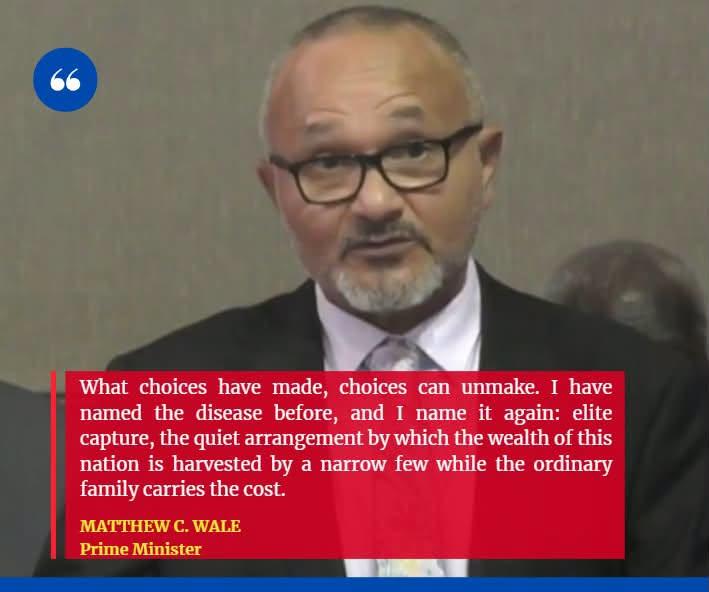
"What choices have made, choices can unmake. I have named the disease before, and I name it again: elite capture, the quiet arrangement by which the wealth of this nation is harvested by a narrow few while the ordinary family carries the cost."
He said the GREAT Coalition Government was pursuing reforms designed to address long-standing economic inequalities and ensure the country's natural wealth delivers wider benefits.
According to Wale, the government's agenda reflects priorities expressed by citizens in villages, markets and churches, and through the ballot box.
"Our ambition is clear: that within the next 20 to 30 years, Solomon Islands will stand among the middle-income countries of the world, not by the charity of others, but through the disciplined harvest of our own God-given wealth," he said.
Wale said the success of the government's economic programme would be measured by its impact on households, particularly market vendors, farmers, fishers and unemployed graduates.
"This transformation will be judged by whether it reaches the ordinary family, the mother at the market, the fishermen and farmers in our provinces, and the young graduate walking the streets of Honiara with a certificate but no job," he said.
The Prime Minister said the government intends to shift the country's development model away from exporting raw resources towards greater domestic value addition.
"We are shifting to a model where the harvest of our land and seas is processed by Solomon Islander hands, on Solomon Islands soil, for Solomon Islander families," he said.
Wale said the change would require a fundamental reorientation of government policies as the administration seeks to build a more inclusive and resilient economy.