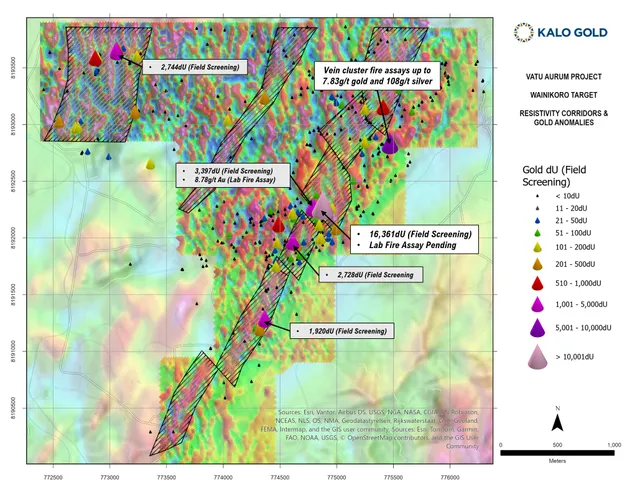
Kalo Gold Corp has identified a new high-grade gold-silver vein target at its Vatu Aurum Project in Fiji, with reconnaissance rock sampling returning up to 7.83 grams per tonne gold and 108g/t silver.
The company said seven rock samples collected from a previously unsampled outcrop in the northeast of the Wainikoro target returned gold grades of up to 7.83g/t and silver grades of up to 108g/t. Five of the seven samples assayed above 2g/t gold, while three returned more than 4g/t gold.
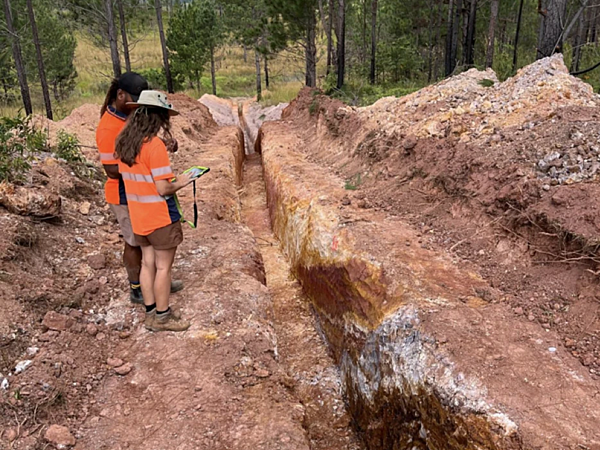
The outcrop, named the New Vein Cluster, contains two intersecting sets of epithermal quartz veins exposed over approximately 15 metres of strike. The veins trend NNW-SSE and east-west, with neither set closed off at the exposed outcrop because both continue beneath overburden.
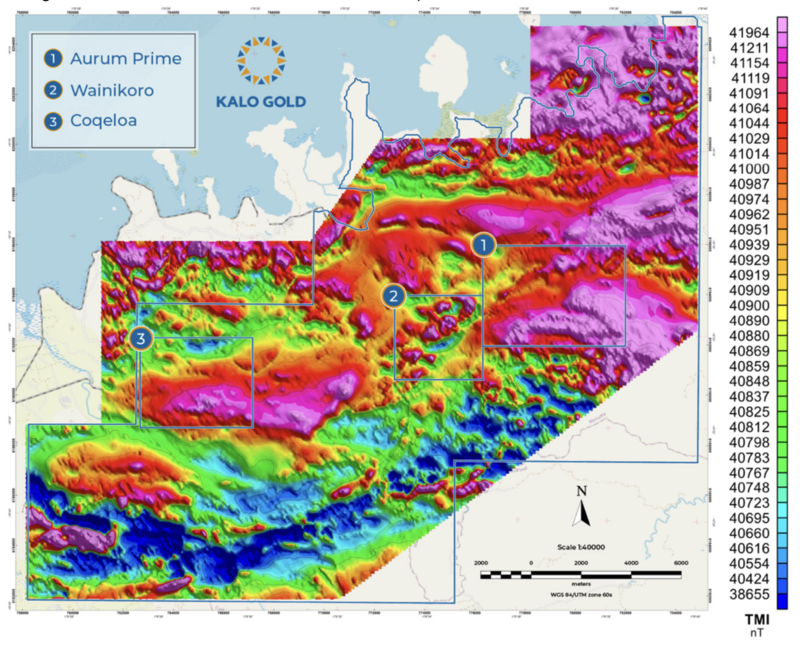
Kalo said the target is approximately 270 metres northeast of the principal Wainikoro graben structure, along the margin of a discrete magnetic low. It is also about 900 metres northeast of 2026 drill hole VA26-DH19 and occurs within predominantly andesitic volcanic rocks.
The company interprets the contrasting vein orientations and cross-cutting relationships as evidence of at least two episodes of veining and hydrothermal activity. The mineralisation displays textures and geochemical characteristics associated with a low-sulphidation epithermal system, including elevated gold, silver, arsenic, antimony, lead and zinc.
Highest-grade samples
The strongest result came from sample WKE-LR26-017A, which returned 7.83g/t gold and 99.7g/t silver. Another sample, WKE-LR26-025D, returned 4.02g/t gold and 105g/t silver.
Other samples included grades of 5.36g/t gold and 54.6g/t silver, 2.32g/t gold and 77.1g/t silver, and 2.10g/t gold and 33.7g/t silver.
Kalo president and chief executive Terry L. Tucker said the results were significant not only because of the grades but also because the mineralisation occurs across two intersecting vein orientations.
“What makes it more than a good rock sample is the structure,” Tucker said, adding that both vein sets remain open beneath cover and will be targeted through trenching and geophysical surveys.
Follow-up exploration planned
Kalo plans additional geological mapping, structural measurements, channel sampling and trenching across the New Vein Cluster to test the continuity of the veins beneath overburden.
A ground geophysical programme is also underway across Wainikoro, comprising gradient-array induced polarisation (IP), gravity and controlled-source audio-frequency magnetotellurics (CSAMT).
The gradient-array IP survey began on 31 July, with five of eight survey blocks completed. The remaining blocks are scheduled for completion by late September. Gravity surveying began on 14 August and is also scheduled to finish in late September, while CSAMT is expected to begin in late September and continue into October.
Kalo expects integrated interpretation and final geophysical reporting to be completed in November 2026.
The company said the geophysical results will be combined with geological mapping, soil geochemistry, airborne magnetic and radiometric data and laboratory results to refine the Wainikoro geological model and identify priority drill targets.
Kalo cautioned that the rock samples are selective in nature and may not be representative of mineralisation across the wider property. No mineral resource or mineral reserve has been estimated for the Vatu Aurum Project, and the exploration targets remain conceptual.
Kalo's 100%-owned Vatu Aurum Project covers 367 square kilometres on Vanua Levu, Fiji, where the company is exploring a northeast-trending corridor of low-sulphidation epithermal gold targets, including Wainikoro and the Aurum Prime area.