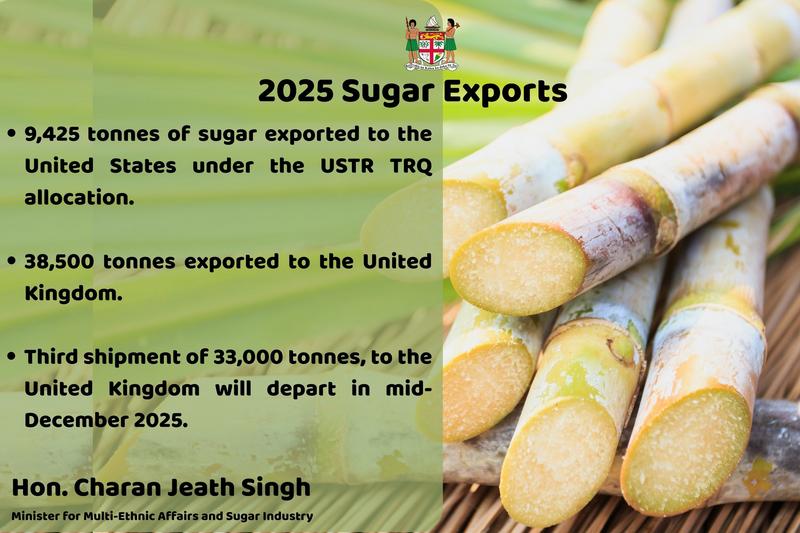

Fiji has surpassed its sugar export quotas to the United States for five consecutive years, reaffirming the reliability of the Fiji Sugar Corporation (FSC) under the U.S. Tariff-Rate Quota (TRQ) system.
Minister for Sugar and Multi-ethnic Affairs Charan Jeath Singh told Parliament that since 2020, Fiji has not only met but exceeded its allocated quota each year.
In 2020, Fiji was allocated 14,330 tonnes and exported 15,611 tonnes. The trend continued in 2021, with exports reaching 10,551 tonnes against a 9,477-tonne allocation. In 2022, FSC exported 12,539 tonnes, exceeding the 11,785-tonne quota.
The 2023 and 2024 seasons each carried an allocation of 9,682 tonnes. Exports again surpassed expectations, totalling 13,760 tonnes in 2023 and 13,877 tonnes in 2024.
“This strong historical performance clearly demonstrates FSC’s capacity and reliability in honouring the requirements of the U.S. TRQ arrangement,” Minister Singh said.
Fiji’s sugar industry produces approximately 450,000 to 500,000 tonnes of raw sugar annually, with the majority processed at FSC’s two main mills in Lautoka and Rarawai. The sector employs tens of thousands of Fijians and plays a critical role in rural livelihoods, particularly in the Western Division, where sugarcane cultivation is a primary source of income.
The U.S. Tariff-Rate Quota (TRQ) allows a fixed quantity of sugar from Fiji to enter the United States at a reduced tariff. For Fiji, this quota has ranged between 9,000 and 15,000 tonnes in recent years, depending on U.S. allocations under the Generalised System of Preferences and bilateral arrangements. Sugar exports above this quota are subject to standard import tariffs, which are higher and less competitive on the global market.
Minister Singh noted that while the U.S. market remains important, it represents only a small segment—around 13,000 tonnes—of Fiji’s annual sugar exports. Over recent years, Fiji has broadened its global presence, strengthening trade with major destinations including the United Kingdom, Europe, South Korea, Asian refiners, and neighbouring Oceania markets.
The Minister emphasised that this diversification continues to enhance Fiji’s resilience and secure long-term stability for the sugar industry.