The Cook Islands Government has launched a new online energy dashboard to provide households, businesses and communities with up-to-date information on the country's fuel position as authorities respond to ongoing global fuel supply pressures.
The dashboard forms part of the Government's broader response under the National Energy Response Framework, a Cabinet-approved plan that sets out how the country will respond to different stages of the global fuel crisis.
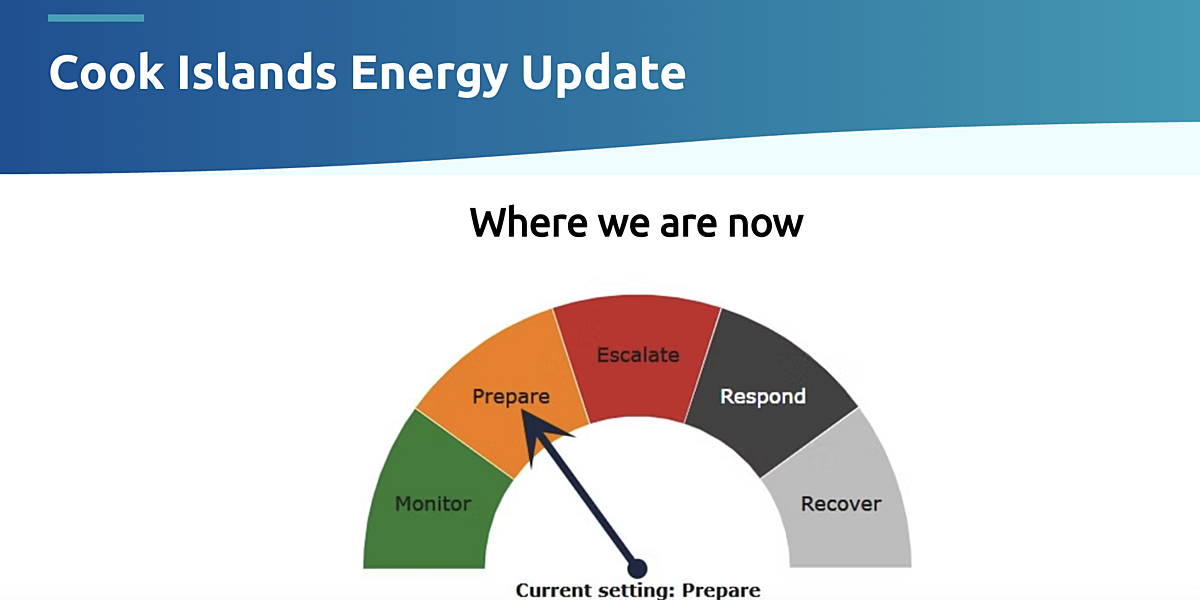
Developed by the Energy Response Technical Working Group (TWG), the framework uses a five-stage traffic-light system comprising Green (Monitor), Amber (Prepare), Red (Escalate), Black (Respond) and Recovery (Transition). The Cook Islands is currently operating under the Amber phase, reflecting rising pressure on global fuel supplies and prices while domestic fuel services continue to operate normally.
The dashboard is intended to strengthen fuel supply monitoring and improve transparency by providing regular updates on fuel stocks, shipment schedules, estimated days of supply remaining and the status of key fuel infrastructure.
According to the Government, monitoring fuel availability is a critical component of the Amber phase, helping ensure the country remains prepared and able to respond quickly to changing global conditions.
The dashboard tracks fuel availability across the Cook Islands, including stock levels on individual islands, fuel consumption rates and the timing of future fuel shipments. Officials said the information will support coordinated decision-making across government agencies and industry stakeholders while helping the public stay informed.
The TWG has established a set of core indicators that serve as an early warning system for potential supply disruptions. The indicators are designed to provide a clear and consistent picture of the country's fuel position and support timely intervention where required.
Current data show that Rarotonga has adequate supplies of all fuel types, with shipments continuing to arrive as scheduled.
Across the Pa Enua, the Government said it is working closely with island administrations and fuel suppliers to maintain fuel security through planned deliveries and ongoing monitoring. Authorities noted that transport and storage constraints in the outer islands require continued coordination between Island Governments, shipping operators and suppliers.
Prime Minister Mark Brown said the National Energy Response Framework provides a structured approach to managing the challenges posed by the global fuel situation.
“We are facing an external shock that we must respond to with discipline and care,” Brown said.
“This framework gives our community certainty about how Government will act at each stage, and what we are asking of every household and business. It also ensures that the Pa Enua are a priority in everything we do.”
“The most important step we can all take right now is to use fuel wisely. Every litre we save today is a litre that goes towards keeping our hospital running, our schools open, our airport moving, and our families supported,” he said.
Financial Secretary Garth Henderson said reliable information remains central to the Government's fuel security strategy.
“Our approach is to stay ahead of the situation by having clear, reliable information on our fuel position across the country,” Henderson said.
“We are tracking supply, usage, and incoming shipments closely, and sharing that information to support coordinated decision-making across Government.”
He said the framework brings together ongoing work across government into a single structure that allows both policymakers and the public to understand how decisions are made.
“What this framework does is take the work the Energy Response Technical Working Group has been doing — monitoring fuel supply, coordinating across agencies, supporting the Pa Enua, communicating with the public — and gives it shape and predictability,” Henderson said.
“Cabinet decisions to move between phases will be guided by clear criteria, and the community will know what phase we are in, what measures are in place, and what is being asked of them at each stage.”
Henderson emphasized that the country's fuel position remains stable despite global pressures.
“Importantly, our current supply position is stable, and shipments are continuing to arrive. We are in the Amber phase of the National Energy Response Framework, which means we have fuel and the most effective step every household and business can take is to use fuel wisely. Every litre saved helps extend our reserves and protect essential services,” he said.
Under the current Amber phase, several measures have already been implemented, including energy conservation directives for public sector agencies, restrictions on government vehicle use, the introduction of free bus services and additional public transport routes for three months, and extended income support for welfare beneficiaries.
Public awareness campaigns are also encouraging households, businesses and tourism operators to adopt energy conservation measures and avoid panic buying or fuel stockpiling.
The framework outlines additional measures that could be introduced if conditions deteriorate. Under the Red phase, the Government could implement spending limits on petrol and diesel purchases, restrictions on government travel and operating hours, and targeted support for low-income workers.
If conditions reach the Black phase, a National State of Emergency could be declared, with measures including temporary electricity rationing and restrictions on non-essential domestic travel.
The Government said all measures under the framework would be targeted, time-limited and assessed based on their effectiveness, economic impact and fiscal cost.
The framework also places the Pa Enua at the center of planning and response efforts, recognizing that outer islands face longer resupply times and more limited fuel storage capacity. Additional work is underway to strengthen fuel storage, improve supply coordination and build community resilience across the islands.
Officials said the dashboard will be updated weekly to ensure the public has access to the latest information on fuel availability and shipment schedules.
The Government added that the current fuel supply challenge reinforces, rather than delays, the Cook Islands' renewable energy ambitions. The country currently generates just over 30 percent of its electricity from renewable sources and is targeting 60 percent renewable electricity generation by 2030.
Authorities said they will continue working closely with suppliers, island administrations and regional partners to maintain fuel security while navigating ongoing global fuel market pressures.