
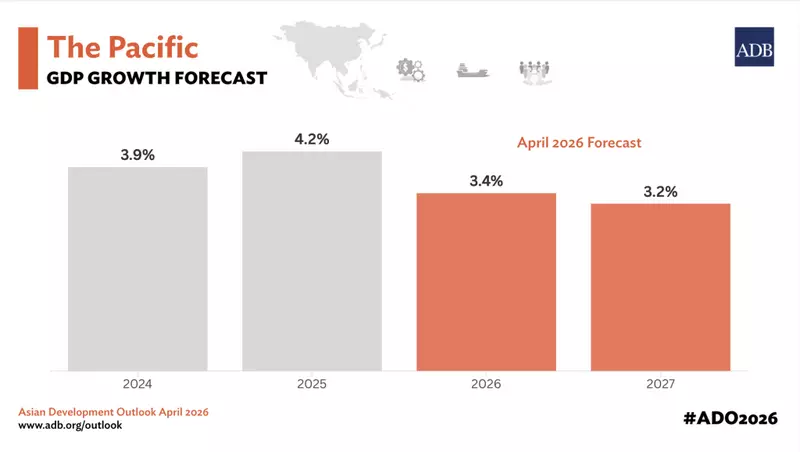
Economic growth in the Pacific is projected to moderate to 3.4% in 2026 and 3.2% in 2027, according to the Asian Development Outlook (ADO) April 2026, the Asian Development Bank's (ADB) flagship economic publication.
“There is an unprecedented need for the Pacific to build resilience against the economic impacts of the Middle East conflict,” said ADB Director General for the Pacific, Emma Veve. “Higher oil prices, prolonged international commodity price spikes, and trade uncertainty, in particular, will weigh on subregional growth momentum.”
The ADO’s regional forecasts are informed by assumptions finalised on 10 March under exceptionally high uncertainty, envisaging an early stabilisation scenario for the conflict in the Middle East. Evidence since then points to a higher likelihood of more persistent disruptions. ADO April 2026 includes a section assessing the impact of the conflict on economies in the region under alternative scenarios. The adverse effects of the current Middle East crisis on both growth and inflation are likely to intensify if the duration and severity of the conflict increase.
The ADB report projects inflation in the Pacific to pick up to 4.2% in 2026, before moderating to 3.5% in 2027. Growth in Papua New Guinea (PNG), the subregion’s largest economy, is forecast to ease to 3.6% in 2026 and 3.4% in 2027, dictated by mixed performances across the resource and non-resource sectors. Mining is likely to remain a key growth driver in both 2026 and 2027, with higher production anticipated at Porgera and Lihir. Structural challenges—particularly power shortages, security, the efficiency of public capital spending, and skilled human resources—continue to weigh on the outlook, amplified by inflationary pressures from the conflict in the Middle East.
In Fiji, the subregion’s second-largest economy, growth is projected to moderate from 3.0% in 2025 to 2.9% in 2026 and further to 2.7% in 2027, as visitor arrivals slow and investors exercise caution ahead of the general elections. Non-communicable diseases continue to strain Fiji’s health system and threaten productivity. Increased health investment and reform, especially in primary care, are needed to strengthen long-term health outcomes and system resilience.
ADO April 2026 projects growth in Solomon Islands to moderate to 3.0% in 2026 from 3.6% in 2025, as mining eases, while higher oil prices associated with the Middle East conflict are likely to dampen economic activity and put upward pressure on inflation.
Growth in Vanuatu is projected to increase to 4.7% in 2026 before moderating to 3.9% in 2027. Continued post-earthquake reconstruction of public infrastructure and private assets, together with the public investment programme, is expected to sustain construction and related services. In the Central Pacific, growth is expected to ease in Kiribati (to 3.1% in 2026 and further to 2.6% in 2027) and in Tuvalu (to 2.5% in 2026 and 2.4% in 2027), as the pace of fiscal expansion slows. Growth in Nauru is projected to remain stable at 2.5% in both 2026 and 2027, supported by development partner assistance.
Growth in North Pacific economies of the Marshall Islands and Palau is projected to follow divergent paths, while economic growth in the Federated States of Micronesia (FSM) is expected to remain stable. In the Marshall Islands, growth is projected to increase to 3.7% in 2026 from 3.0% in 2025, before moderating to 2.8% in 2027. In the FSM, growth is forecast to remain at 1.0% in both 2026 and 2027, while in Palau, growth is expected to decelerate to 6.0% in 2026 and further to 3.7% in 2027.
Across the South Pacific economies of the Cook Islands, Niue, Samoa, and Tonga, growth is moderating as tourism normalises and major projects wind down. Inflation has generally eased but remains vulnerable to external shocks, particularly those affecting energy and import prices. Growth is projected to moderate to 2.7% in 2026 and rise to 3.0% in 2027 in the Cook Islands, and to 3.2% in 2026 and 3.0% in 2027 in Samoa. Meanwhile, growth is expected to remain stable at 2.5% in both 2026 and 2027 in Niue, and at 2.3% over the same period in Tonga.
ADB is a leading multilateral development bank supporting sustainable, inclusive, and resilient growth across Asia and the Pacific. Working with its members and partners to solve complex challenges together, ADB harnesses innovative financial tools and strategic partnerships to transform lives, build quality infrastructure, and safeguard the planet. Founded in 1966, ADB is owned by 69 members—50 from the region.