

Kalo Gold Corp. has identified multiple in-situ low-sulphidation epithermal quartz veins at the Wainikoro prospect within its wholly owned Vatu Aurum Project in Fiji, as the company advances exploration and prepares for the next phase of drilling.
The company reported surface values of up to 3,397 detectORE units (dU), equivalent to an estimated 3.40 grams of gold per tonne, from quartz vein float surrounding a newly identified in-situ chalcedonic quartz vein. The vein itself returned 1,157 dU, equivalent to an estimated 1.16 g/t gold. The results form part of Kalo Gold's 2026 surface exploration programme at Wainikoro.
Kalo Gold said the latest geological mapping, soil geochemistry and airborne magnetic survey data have expanded the previously identified arsenic-in-soil anomaly at Wainikoro from more than one kilometre to approximately 1,800 metres of strike length. The anomaly is oriented north-west to south-east within a central magnetic-low feature that the company believes represents a key structural control on mineralisation.
Additional surface sampling returned values of 2,728 dU from a chalcedonic-banded quartz vein hosted in silicified bedded tuff and 1,364 dU from an adjacent silicified polymictic volcanic breccia. Other samples from silicified host rocks and epithermal quartz veins also returned elevated gold responses.
Trenching undertaken as part of the programme returned channel sample values of up to 1,446 dU. A 13-metre interval in trench TR26-011 averaged 275 dU within silicified fault-controlled structures, while point samples returned values of 724 dU and 701 dU from separate trench locations. The company noted that detectORE values are used for exploration screening purposes and are not equivalent to certified fire assay results.
According to Kalo Gold, the latest results support its revised geological interpretation announced in May, which views the 367-square-kilometre Vatu Aurum Project as a single, multi-phase, structurally reactivated volcanic complex rather than a collection of separate prospects. The company said geological mapping, trenching, soil geochemistry, detectORE screening and airborne magnetic data are increasingly converging on the same structural targets at Wainikoro.
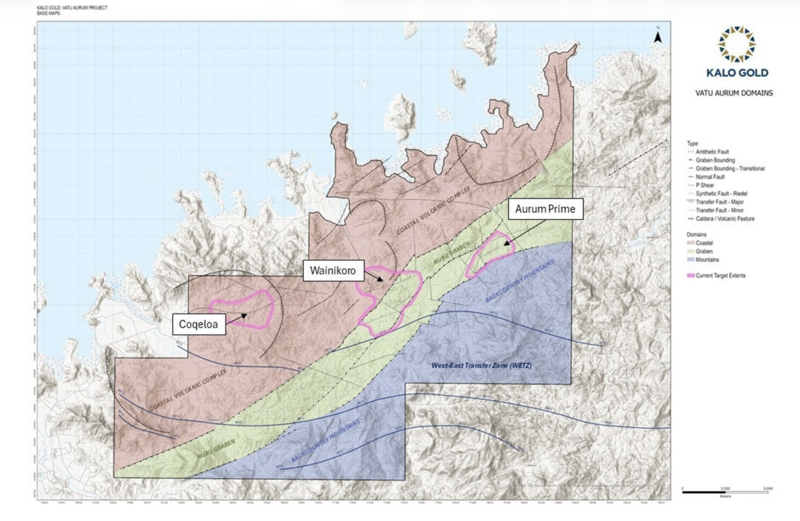
The company identified the West-East Transfer Zone as a regional corridor for fluid movement and said north-west to south-east trending oblique faults, transfer faults and shear structures appear to play a significant role in controlling gold mineralisation across the project area. The strongest gold responses occur where these structures intersect the transfer zone and the margins of the Nubu Graben.
Kalo Gold has completed a 6,212 line-kilometre airborne magnetic and radiometric survey across the project and is integrating the results with geological mapping, trenching and geochemical data. The company plans to mobilise an induced polarisation survey at Wainikoro in July, with drilling expected to follow after completion of the integrated geological and geophysical interpretation.
The 2026 exploration programme has collected 9,994 soil samples to date, with a further 5,390 samples planned across newly defined magnetic targets. Preliminary portable XRF analysis continues to identify arsenic, antimony and mercury anomalies associated with magnetic-low features, supporting the company's interpretation of a large low-sulphidation epithermal gold system.
Looking ahead, Kalo Gold said it will undertake follow-up trenching at the newly identified chalcedonic quartz vein and adjacent silicified breccia and quartz-vein targets at Wainikoro to better define the extent of mineralisation. The planned induced polarisation survey will test the subsurface geometry of magnetic-low features and structural intersections identified through recent geological and geophysical work.
The company also plans to complete the integration of airborne magnetic and radiometric survey data into its project-wide geological model, while advancing a bulk leach extractable gold stream-sediment sampling programme and detailed geological mapping at the Coqeloa prospect. Kalo Gold said further drilling across the Vatu Aurum Project will not commence until the airborne magnetic dataset has been fully incorporated into the exploration model. The company is also awaiting certified fire assay results from drill holes VA26-DH18 and VA26-DH19.
President and Chief Executive Officer Terry Tucker said the company had progressed from identifying kilometre-scale arsenic anomalies in soil to discovering multiple in-situ epithermal quartz veins in rock, including the newly identified chalcedonic vein. He said the integration of geological mapping, structural interpretation, geophysics, trenching and geochemistry was helping define a growing pipeline of drill-ready targets across the Vatu Aurum Project.
“We have moved Wainikoro from kilometre-scale arsenic anomalies in soil to multiple in-situ epithermal quartz veins in rock in the last month — including a newly identified chalcedonic vein — with detectORE™ surface values up to 3,397 dU, approximately 3.4 g/t Au estimated. That is a real step forward," Tucker said.
"What I find particularly compelling is that our geological mapping, structural interpretation, airborne geophysics, trenching and geochemistry are now converging on the same ground at Wainikoro — telling us not only where the gold sits but why it sits there. As we trench the vein targets, plan to mobilise IP in July, and integrate the 6,212 line-kilometre airborne magnetic datasets, we are building a strong pipeline of drill-ready opportunities across the Vatu Aurum Project," he added.
The Vatu Aurum Project covers 367 square kilometres on Vanua Levu and contains a series of low-sulphidation epithermal gold targets that Kalo Gold is advancing through drilling, trenching, geochemistry, structural mapping and airborne geophysical surveys.


